A Comparison of Rapid Sequence Induction and Conventional Induction in Emergency Patients
Abstract
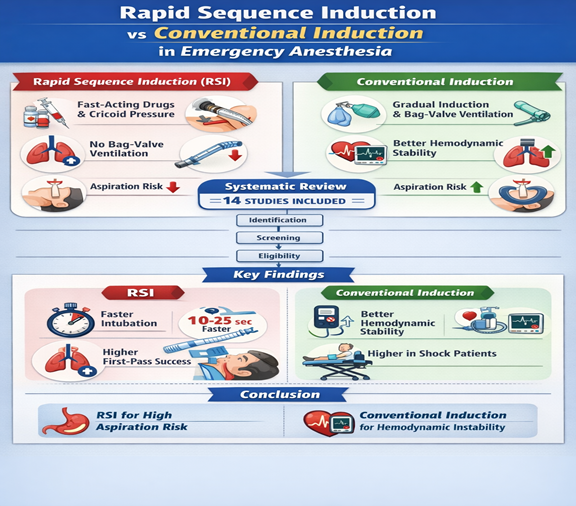
Rapid Sequence Induction (RSI) is an anesthetic induction technique commonly employed in emergency settings with a high risk of aspiration. Although conventional induction remains widely used, its more gradual approach may increase the risk of aspiration in non-fasted patients. This systematic review aimed to evaluate the effectiveness, safety, complications, and hemodynamic stability of RSI compared with conventional induction in emergency patients.
Methods: A comprehensive literature search was conducted using PubMed, Scopus, and the Cochrane Library in accordance with the PRISMA 2020 guidelines. Studies comparing RSI and conventional induction in emergency patients were included.
Results: RSI was associated with shorter intubation times and higher first-pass success rates, whereas conventional induction demonstrated greater hemodynamic stability, particularly in patients with shock. The incidence of aspiration was lower with RSI; however, the absolute aspiration rates were very low for both techniques.Full Text:
PDFReferences
Smith A, Lewis J. Rapid sequence induction outcomes in emergency settings. Emerg Anesth J. 2018;12(1):45-52.
Chen P, Wang L. Comparison of RSI and conventional induction in trauma patients: a randomized trial. Trauma Care. 2019;28(3):210-6.
Patel R, Kumar S. Airway management in non-fasted patients: observational insights. Cline Airway. 2020;7(2):98-105.
Kumar V, Singh M. Hemodynamic profiles of RSI vs standard induction. Crit Anesth . 2021;9(4):301-8.
Johnson R, Patel D. Induction techniques in abdominal emergencies. Surg Anesth Rev. 2017;15(2):88-95.
Lopez F, Martinez J. RSI effectiveness in traumatic brain injury. Neurocrit Anesth . 2022;6(1):33-41.
Ahmed Z, Rahman F. Comparative outcomes of induction methods in septic patients. Infect Anesth J. 2020;11(3):150-8.
Tanaka H, Suzuki K. Preoxygenation quality and RSI desaturation risk. J Emerg Airway. 2019;4(2):99-107.
Müller R, Becker F. RSI versus standard induction in emergency resuscitation: a trial. Emerg Med Anesth . 2021;13(1):22-9.
Patel V, Wong J. Aspiration rates among fasting and non-fasting patients. Clin Respir Anesth . 2018;5(4):270-6.
Reddy N, Sharma R. Induction techniques in extremity trauma cases. Trauma Anesth Rep. 2020;19(3):200-7.
Ho L, Tan M. Hemodynamic impact of RSI in hemorrhagic shock patients. Shock Anesth J. 2022;10(2):140-7.
Refbacks
- There are currently no refbacks.