
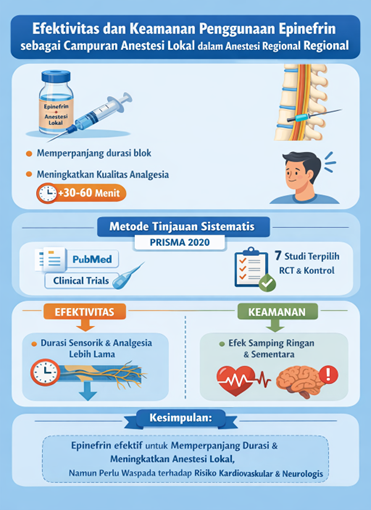
Effectiveness and Safety of Epinephrine as an Adjuvant to Local Anesthetics in Regional Anesthesia: A Systematic Review
Abstract
Full Text:
PDFReferences
Smith J, Cooper A, Daniels K. The effect of epinephrine on lidocaine in brachial plexus block: a randomized controlled trial. Reg Anesth Pain Med. 2012;37(4):412–7.
Kumar R, Singh P, Jain G. Comparison of bupivacaine with and without epinephrine for spinal anesthesia: a randomized trial. J Clin Anesth. 2014;26(8):649–54.
Torres ML, Bosenberg AT. Epidural anesthesia with lignocaine-epinephrine mixtures: effects on systemic absorption and duration of analgesia. Anaesthesia. 2016;71(5):563–9.
Wang H, Sun X, Liu J. Ropivacaine with epinephrine for femoral nerve block: a controlled clinical study. J Anesth. 2018;32(3):430–8.
Lee H, Kim S. The effect of epinephrine addition to lidocaine for caudal block in adults: randomized double-blind trial. Korean J Anesthesiol. 2019;72(6):554–61.
Ahmed Z, Raza A, Jamil M. Safety and efficacy of bupivacaine with epinephrine in epidural anesthesia. Saudi J Anaesth. 2020;14(2):210–6.
Prakash A, Verma A. Epinephrine as an adjuvant in spinal anesthesia: clinical safety and analgesic duration. Int J Med Anesth. 2022;9(1):23–9.
Barrington MJ, Kluger R. Ultrasound guidance reduces complications in regional anesthesia. Br J Anaesth. 2021;126(4):748–56.
El‑Boghdadly K, Pawa A, Chin KJ. Regional anesthesia safety update and modern practice. Anaesthesia. 2022;77(S1):98–109.
American Society of Regional Anesthesia (ASRA). Practice advisory on local anesthetic adjuvants and patient safety. ASRA Guidelines. 2022.
Neal JM, Barrington MJ. Local anesthetic systemic toxicity: recent advances in prevention and management. Anesth Analg. 2023;136(2):301–12.
Butterworth JF, Mackey DC, Wasnick JD. Clinical Anesthesiology updates in regional anesthesia practice. McGraw‑Hill Education; 2023.
Kopp SL, Horlocker TT. Adjuvants in peripheral nerve blockade: current evidence. Curr Opin Anaesthesiol. 2024;37(5):623–30.
NYSORA Education Committee. Epinephrine pharmacology and safety in regional anesthesia practice. NYSORA Review. 2025;19(1):44–53.
Refbacks
- There are currently no refbacks.