Early Lactate-Guided Resuscitation in Septic Shock Patients in the ICU
Abstract
Background: Septic shock is a critical condition in the intensive care unit (ICU) with persistently
high mortality. Early resuscitation plays a key role in improving tissue perfusion, and serum lactate
and lactate clearance have been used as markers of hypoperfusion and response to resuscitation.
However, the effectiveness of early lactate-guided resuscitation on clinical outcomes remains to
be systematically evaluated. Objective: To assess the effectiveness of early lactate-guided
resuscitation on clinical outcomes in patients with septic shock treated in the ICU. Methods: This
study was conducted as a systematic review in accordance with the PRISMA guidelines. A
literature search was performed in the PubMed database through 2025. Studies involving adult
patients with septic shock in the ICU that used serum lactate or lactate clearance as a target for
early resuscitation were included. Study selection was conducted through title and abstract
screening, followed by full-text review based on predefined inclusion and exclusion criteria. Data
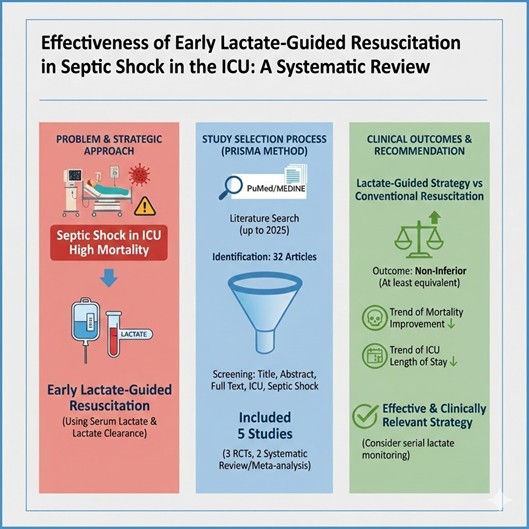
were synthesized narratively. Results: Of the 32 articles identified, five studies met the inclusion
criteria, comprising three randomized controlled trials and two systematic reviews/meta-analyses.
Overall, early lactate-guided resuscitation demonstrated clinical outcomes that were at least non-
inferior to conventional resuscitation strategies, with a trend toward improved mortality, shorter
ICU length of stay, and better clinical parameters in several studies. Conclusion: Early lactate-
guided resuscitation is an effective and clinically relevant strategy in the management of septic
shock in the ICU. Serial monitoring of serum lactate and lactate clearance may be considered as
targets for early resuscitation to support improved patient outcomes.Keywords: septic shock;
lactate; lactate clearance; early resuscitation; ICU
Full Text:
PDFReferences
Singer M, Deutschman CS, Seymour CW, et al. The Third International Consensus Definitions for Sepsis and Septic Shock (Sepsis-3). JAMA. 2016;315(8):801–810.
Vincent JL, Moreno R, Takala J, et al. The SOFA (Sepsis-related Organ Failure Assessment) score to describe organ dysfunction/failure. Intensive Care Med. 1996;22(7):707–710.
Marty P, Roquilly A, Vallée F, et al. Lactate clearance for death prediction in severe sepsis or septic shock patients during the first 24 hours in the intensive care unit. Ann Intensive Care. 2013;3:3.
Evans L, Rhodes A, Alhazzani W, et al. Surviving Sepsis Campaign: International guidelines for management of sepsis and septic shock 2021. Intensive Care Med. 2021;47(11):1181–1247.
Jones AE, Shapiro NI, Trzeciak S, et al. Lactate clearance vs central venous oxygen saturation as goals of early sepsis therapy: a randomized clinical trial. JAMA. 2010;303(8):739–746.
Castro R, Kattan E, Ferri G, et al. Effects of capillary refill time- vs lactate-guided fluid resuscitation on regional, microcirculatory, and hypoxia-related perfusion parameters in septic shock: a randomized controlled trial. Ann Intensive Care. 2020;10:31.
Chen H, Li Y, Zhang Q, et al. Early lactate clearance-guided therapy in septic shock patients in the intensive care unit: a randomized controlled trial. J Intensive Care Med. 2021;36(7):813–820.
Pan J, Peng M, Liao C, Hu X, Wang A, Li X. Relative efficacy and safety of early lactate clearance-guided therapy in patients with sepsis: a meta-analysis. Medicine (Baltimore). 2019;98(8):e14453.
Graziani A, Donadello K, Taccone FS, et al. Lactate-guided resuscitation in septic shock: a systematic review and meta-analysis. Intern Emerg Med. 2025;20(1):45–56.
Ryoo SM, Lee J, Lee YS, et al. Lactate clearance and prognosis in patients with septic shock. Crit Care. 2018;2:112.
Nguyen HB, Rivers EP, Knoblich BP, et al. Early lactate clearance is associated with improved outcome in severe sepsis and septic shock. Crit Care Med. 2004;32(8):1637–1642.
Casserly B, Phillips GS, Schorr C, et al. Lactate measurements in sepsis-induced tissue hypoperfusion: results from the Surviving Sepsis Campaign database. Crit Care Med. 2015;43(3):567–573.
Mikkelsen ME, Miltiades AN, Gaieski DF, et al. Serum lactate is associated with mortality in severe sepsis independent of organ failure and shock. Crit Care Med. 2009;37(5):1670–1677.
Hernandez G, Ospina-Tascon GA, Damiani LP, et al. Effect of a resuscitation strategy targeting peripheral perfusion status vs serum lactate levels on 28-day mortality among patients with septic shock. JAMA. 2019;321(7):654–664.
Levy MM, Evans LE, Rhodes A. The Surviving Sepsis Campaign bundle: 2018 update. Intensive Care Med. 2018;44(6):925–928.
Refbacks
- There are currently no refbacks.