
Implantable Cardiac Pulse Generators: Pacemakers and Cardioverter-Defibrillators
Abstract
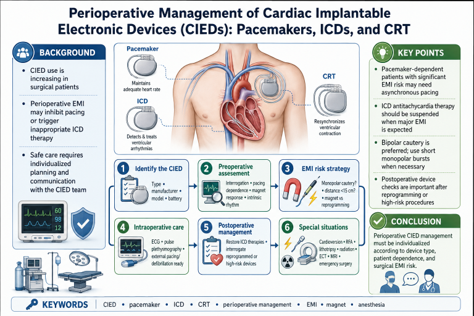
Background: Cardiac implantable electronic devices (CIEDs), including pacemakers, implantable cardioverter-defibrillators (ICDs), and cardiac resynchronization therapy (CRT) devices, are increasingly encountered in perioperative patients. Electromagnetic interference, pacing dependence, magnet response, and changes in antitachycardia therapy may pose clinically significant risks if not recognized. Objective: To summarize the principles of CIED function and develop a practical approach to preoperative evaluation, intraoperative and postoperative management, special procedures, and evolving CIED technologies. Methods: This article is a narrative review based on the provided textbook-reading chapter, while retaining the supporting literature cited in the source. The synthesis was organized according to device type, electromagnetic interference risk, magnet-use versus reprogramming strategies, monitoring, emergency protocols, specific high-risk procedures, and developments in leadless devices. Results: Perioperative assessment should identify the CIED type and manufacturer, most recent interrogation results, battery longevity, pacemaker dependence, intrinsic rhythm, pacing thresholds, and magnet response. The risk of electromagnetic interference is primarily associated with monopolar electrocautery, particularly when the current pathway is above the umbilicus or close to the generator/leads. In patients with an ICD, antitachycardia therapies should be disabled when EMI risk is present, whereas pacemaker-dependent patients may require asynchronous pacing. Magnet application has different effects on pacemakers and ICDs; therefore, the device response must be known in advance. Monitoring of mechanical capture using plethysmography or an arterial waveform is important during surgery. After surgery, suspended therapies should be promptly restored, and interrogation should be performed in high-risk conditions. Conclusion: Perioperative CIED management should be individualized according to device characteristics, pacing dependence, surgical site, and EMI risk. Communication between the anesthesiology team and the CIED team is a central component in preventing underpacing, inappropriate ICD therapy, device reset, and hemodynamic compromise.
References
References
Porkorney SD, Miller AL, Chen AY, et al. Implantable cardioverter-defibrillator use among medicare patients with low ejection fraction after acute myocardial infarction. JAMA. 2015;313(24):2433–2440.
Kremers MS, Hammill SC, Berul CI. The National ICD Registry Report: version 2.1 including leads and pediatrics for years 2010 and 2011. Heart RhythM. 2013;10(4):e59–65.
Crossley GH, Poole JE, Rozner MA, et al. The Heart Rhythm Society (HRS)/American Society of Anesthesiologists (ASA) Expert Consensus Statement on the perioperative management of patients with implant-able defibrillators, pacemakers, and arrhythmia monitors: facilities and patient management this document was developed as a joint project with the American Society of Anesthesiologists (ASA), and in collabo-ration with the American Heart Association (AHA), and the Society of Thoracic Surgeons (STS). Heart RhythM. 2011;8(7):1114–1154.
Practice advisory for the perioperative management of patients with cardiac implantable electronic devices: pacemakers and implantable cardioverter-defibrillators 2020: an updated report by the American Society of Anesthesiologists task force on perioperative management of patients with cardiac implantable electronic devices. Anesthesiology. 2020;132:225–252.
Levine PA, Isaeff DM. Follow-up management of the paced patient. In: Kusumoto FM, Goldschlager NF, eds. Cardiac Pacing for the Clinician. 2nd ed. New York: Springer; 2008:647–694.
Levine PA. Pacemaker dependency after pacemaker implantation. Cardiol J. 2007;14:318–320.
Bernstein AD, Daubert J-C, Fletcher RD, et al. The revised NASPE/ BPEG generic code for antibradycardia, adaptive-rate, and multisite pacing. J Pacing Clin Electrophysiol. 2002;25.
Lambiase PD, Srinivasan NT. Early experience with the subcutaneous ICD. Curr Cardiol Rep. 2014;16:516.
Hernandez AF, Fonarow GC, Hammill BG, et al. Clinical effectiveness of implantable cardioverter-defibrillators among medicare beneficia-ries with heart failure. Circ Heart Fail. 2010;3:7–13.
Al-Khatib SM, Hellkamp AS, Fonarow GC, et al. Association between prophylactic implantable cardioverter-defibrillators and survival in patients with left ventricular ejection fraction between 30% and 35. JAMA. 2014;311:2209–2215.
Mezu U, Adelstein E, Jain S, et al. Effectiveness of implantable defibril-lators in octogenarians and nonagenarians for primary prevention of sudden cardiac death. AM J Cardiol. 2011;108:718–722.
Pokorney SD, Hellkamp AS, Yancy CW, et al. Primary prevention implantable cardioverter-defibrillators in older racial and ethnic minority patients. Circ ArrhythM Electrophysiol. 2015;8:145–151.
Khazanie P, Hellkamp AS, Fonarow GC, et al. Association between comorbidities and outcomes in heart failure patients with and without an implantable cardioverter-defibrillator for primary prevention. J AM Heart Assoc. 2015;4(8):e002061.
Goldenberg I, Gillespie J, Moss AJ, et al. Long-term benefit of pri-mary prevention with an implantable cardioverter-defibrillator: an extended 8-year follow-up study of the Multicenter Automatic Defi-brillator Implantation Trial II. Circulation. 2010;122:1265–1271.
Hiremath S, Punnam SR, Brar SS, et al. Implantable defibrillators improve survival in end-stage renal disease: results from a multi-center registry. AM J Nephrol. 2010;32:305–310.
Kusumoto FM, Bailey KR, Chaouki AS, et al. Systematic review for the 2017 AHA/ACC/HRS guideline for management of patients with ventricular arrhythmias and the prevention of sudden cardiac death: a report of the American College of Cardiology Foundation/American Heart Association Task Force on clinical practice guidelines and the Heart Rhythm Society. J AM Coll Cardiol. 2018;72(14):1653–1676.
Kramer DB, Kennedy KF, Noseworthy PA, et al. Characteristics and outcomes of patients receiving new and replacement implantable cardioverter-defibrillators: results from the NCDR. Circ Cardiovasc Qual OutcoMes. 2013;6:488–497.
Madhavan M, Friedman PA, et al. Optimal programming of implant-able cardiac defibrillators. Circulation. 2013;128:659–672.
Ho J, Mahajan A. Cardiac resynchronization therapy. ACA;. 2010.
Ypenburg C, Lancellotti P, Tops LF, et al. Mechanism of improvement in mitral regurgitation after cardiac resynchronization therapy. Eur Heart J. 2008;29:757–765.
Kanzaki H, Bazaz R, Schwartzman D, et al. A mechanism for immedi-ate reduction in mitral regurgitation after cardiac resynchronization therapy: insights from mechanical activation strain mapping. J AM Coll Cardiol. 2004;44:1619–1625.
Lindsay BD, Estes III NA, Maloney JD, Reynolds DW. Heart Rhythm Society policy statement update: recommendations on the role of indus-try employed allied professionals. Heart RhythM. 2008;5(11):e8–10.
Niehous M, Tebbenjohanns J. Electromagnetic interference in patients with implanted pacemakers or cardioverter-defibrillators. Heart. 2001;86:246–248.
Lee D, Sharp VJ, Konety BR. Use of bipolar power source for transure-thral resection of bladder tumor in patient with implanted pacemaker. Urology. 2005;66:194.
Wilson JH, Lattner S, Jacob R, Stewart R. Electrocautery does not interfere with the function of the automatic implantable cardioverter defibrillator. Ann Thorac Surg. 1991;51:225–226.
Bayes J. A survey of ophthalmic anesthetists on managing pacemakers and implanted cardiac defibrillators. Anesth Analg. 2010;103:1615–1616.
Lamas GA, Antman EM, Gold JP, et al. Pacemaker backup mode reversion and injury during cardiac surgery. Ann Thorac Surg. 1986;41:155–157.
Mangar D, Atlas GM, Kane PB. Electrocautery-induced pacemaker malfunction during surgery. Br J Anaesth. 1991;38:616–618.
Snow JS, Kalenderian D, Colasacco JA, et al. Implanted devices and electromagnetic interference: case presentation and review. J Invasive Cardiol. 1995;7:25–32.
Furman S, Fisher JD. Endless loop tachycardia in an AV universal DDD pacemaker. Pacing Clin Electrophysiol. 1982;5:486–489.
Katzenberg CA, Marcu FI, Heusinkveld RS, Mammana RB. Pace-maker failure due to radiation therapy. Pacing Clin Electrophysiol. 1982;5:156–159.
Streckenbach S, Lai Y, Bas H, et al. Starting an anesthesia-based periop-erative device management service: a practical guide to training anes-thesiologists. J Cardiothorac Vasc Anesth. 2021;35(4):1006–1017.
Levine PA, Barold SS, Fletcher RD, Talbot P. Adverse acute and chronic effects of electrical defibrillation and cardioversion on implanted unipolar cardiac pacing systems. J AM Coll Cardiol. 1983;1: 1413–1422.
Altamura G, Glanconi L, Lo B. Transthoracic DC shock may represent a serious hazard in pacemaker dependent patients. Pacing Clin Electro-physiol. 1995;18:1–8.
Manegold JC, Israel CW, Ehrlich JR, et al. External cardioversion of atrial fibrillation in patients with implanted pacemaker or cardioverter defibrillator systems: a randomized comparison of monophasic and biphasic shock energy application. Eur Heart J. 2007;28:1731–1738.
Lakkireddy D, Patel D, Ryschon K, et al. Safety and efficacy of radiofre-quency energy catheter ablation of atrial fibrillation in patients with pacemakers and implantable cardiac defibrillators. Heart RhythM. 2005;2:1309–1316.
Ellenbogen KA, Wood MA, Stambler BS. Acute effects of radiofre-quency ablation of atrial arrhythmias on implanted permanent pac-ing systems. Pacing Clin Electrophysiol. 1996;19:1287–1295.
Health Canada Health Products and Food Branch. Notice to Hospitals – interactions between active implantable medical devices and sys-tems and other medical devices. http://www.healthycanadians.gc.ca/recall-alert-rappel-avis/hc-sc/2005/14340a-eng.php.
Platonov M, Gillis A, Kavanagh K. Pacemakers, ICDs and extracorpo-real shockwave lithotripsy: evidence-based guidelines for the modern era. J Endourol. 2008;22(2):243–247.
Hayes DL, Holmes DR, Gray JE. Effect of 1.5 tesla nuclear magnetic resonance imaging scanner on implanted permanent pacemakers. J AM Coll Cardiol. 1987;10:782–786.
Brook C, Mutter M. Pacemaker failure associated with therapeutic radiation. AM J EMerg Med. 1988;6:591–593.
Adamec R, Haefliger JM, Killiscch JP, et al. Damaging effect of thera-peutic radiation on programmable pacemakers. Pacing Clin Electro-physiol. 1982;5:145–150.
Medtronic Micra Model MC1VR01 Manual. http://manuals.medtroni c.com/wcm/groups/mdtcom_sg/@emanuals/@era/@crdm/docume nts/documents/contrib_231758.pdf.
Burke MC, Gold MR, Knight BP, et al. Safety and efficacy of the totally subcutaneous implantable defibrillator: 2-year results from a pooled analysis of the IDE Study and EFFORTLESS Registry. J AM Coll Cariol. 2015;65:1605–1615.
Weiss R, Knight BP, Gold MR, et al. Safety and efficacy of a totally subcutaneous implantable-cardioverter defibrillator. Circulation. 2013;128:944–953.
Lambiase PD, Srinivasan NT. Early experience with the subcutaneous ICD. Curr Cardiol Rep. 2014;16:516.
Refbacks
- There are currently no refbacks.