
DIURETIC MANAGEMENT IN CRITICALLY ILL PATIENTS IN THE INTENSIVE CARE UNIT: A LITERATURE REVIEW
Abstract
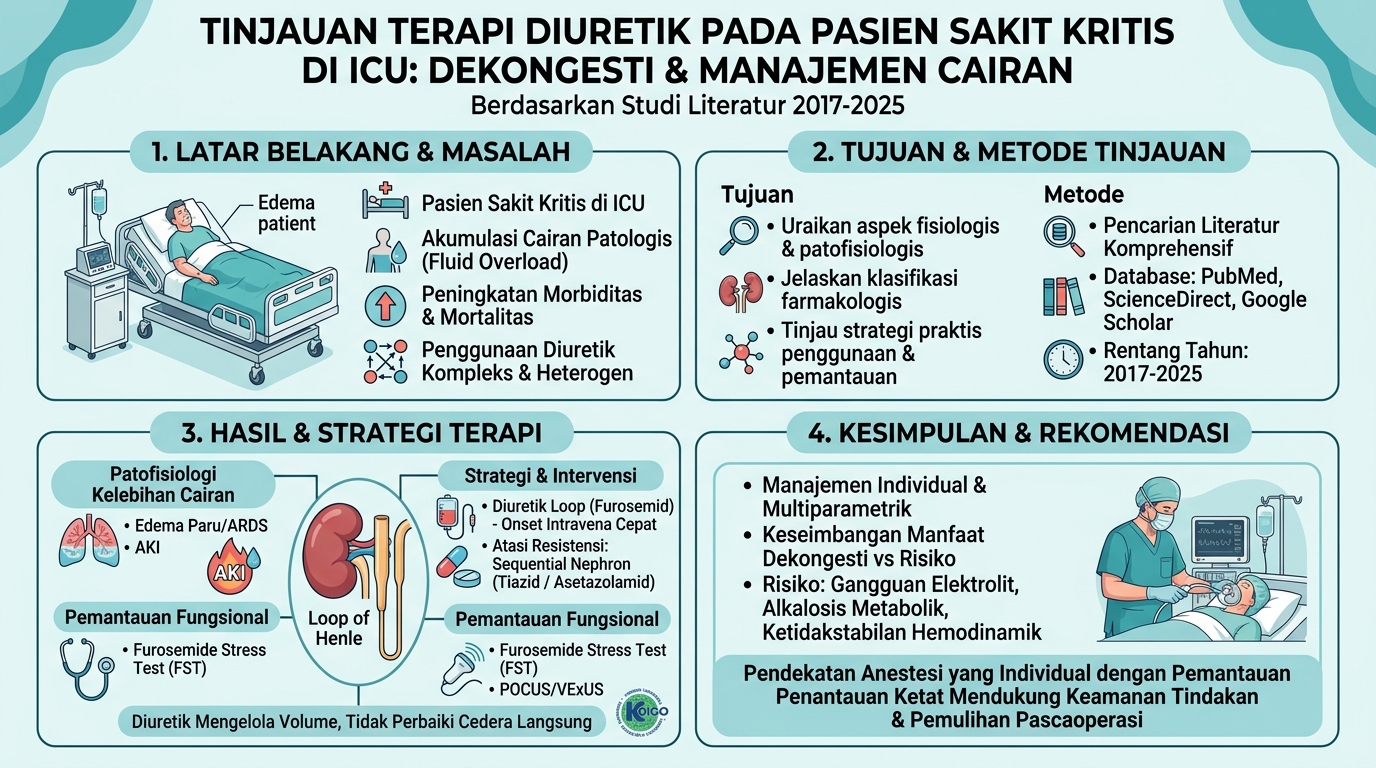
Background: Critically ill patients in the intensive care unit (ICU) frequently experience pathological fluid overload (FO) following aggressive fluid resuscitation, which is strongly associated with increased morbidity and mortality. Loop diuretics, especially furosemide, remain the cornerstone of decongestive therapy. However, their use in critical illness is complex due to patient response heterogeneity and the risk of organ complications. Objective: This literature review aims to comprehensively outline the clinical physiology, pathophysiology, pharmacological classification, and practical strategies for the administration and monitoring of diuretic therapy in critically ill patients. Methods: A comprehensive literature search was conducted across PubMed, ScienceDirect, and Google Scholar for scientific articles, clinical trials, and guidelines relevant to diuretic management in critically ill patients published between 2017 and 2025. Results:Persistent fluid overload worsens pulmonary edema (ARDS) and decreases the renal perfusion gradient due to systemic venous congestion, contributing to acute kidney injury (AKI). Loop diuretics act on the thick ascending limb of the loop of Henle, providing rapid onset when administered intravenously. To overcome diuretic resistance, sequential nephron blockade using thiazides or acetazolamide combinations can be utilized. Functional monitoring using the Furosemide Stress Test (FST) and Point-of-Care ultrasound (POCUS/VExUS) helps assess systemic venous congestion dynamically. Diuretics do not directly cure kidney injury; rather, they are used to manage volume overload in accordance with KDIGO recommendations. Conclusion: Diuretic management in critically ill patients must be individualized through multiparametric evaluation to balance organ decongestion benefits against risks of electrolyte imbalances, metabolic alkalosis, and hemodynamic instability.
References
Kellum JA, Lameire N. Diagnosis, evaluation, and management of acute kidney injury: a KDIGO summary (Part 1). Crit Care. 2013;17(1):204.
Kidney Disease: Improving Global Outcomes (KDIGO) Acute Kidney Injury Work Group. KDIGO clinical practice guideline for acute kidney injury. Kidney Int Suppl. 2012;2(1):1-138.
Hoste EAJ, Clermont G, Kersten A, Venkataraman R, Angus DC, De Bacquer D, et al. RIFLE criteria for acute kidney injury are associated with hospital mortality in critically ill patients: a cohort analysis. Crit Care. 2006;10(3):R73.
Mehta RL, Kellum JA, Shah SV, Molitoris BA, Ronco C, Warnock DG, et al. Acute Kidney Injury Network: report of an initiative to improve outcomes in acute kidney injury. Crit Care. 2007;11(2):R31.
Prowle JR, Bellomo R. Fluid administration and the kidney. Curr Opin Crit Care. 2013;19(4):308-313.
Wiedemann HP, Wheeler AP, Bernard GR, Thompson BT, Hayden D, deBoisblanc B, et al. Comparison of two fluid-management strategies in acute lung injury. N Engl J Med. 2006;354(24):2564-2575.
Silversides JA, Major E, Ferguson AJ, Mann EE, McAuley DF, Marshall JC, et al. Conservative fluid management or deresuscitation for patients with sepsis or acute respiratory distress syndrome following the resuscitation phase of critical illness: a systematic review and meta-analysis. Intensive Care Med. 2017;43(2):155-170.
Bouchard J, Mehta RL. Fluid accumulation and acute kidney injury: consequences and impact. Contrib Nephrol. 2010;165:111-119.
Brater DC. Diuretic therapy. N Engl J Med. 1998;339(6):387-395.
Felker GM, Lee KL, Bull DA, Redfield MM, Stevenson LW, Goldsmith SR, et al. Diuretic strategies in patients with acute decompensated heart failure. N Engl J Med. 2011;364(9):797-805.
Refbacks
- There are currently no refbacks.