
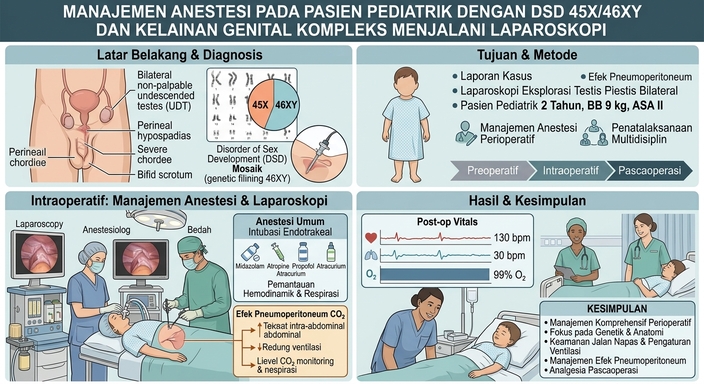
Anesthetic Management of a Patient with 45,X/46,XY DSD Presenting with Perineal Hypospadias, Severe Chordee, Bifid Scrotum, and Bilateral Non-palpable Undescended Testes Undergoing Laparoscopic Surgery
Abstract
Background: Disorder of Sex Development (DSD) with mosaic 45X/46XY is a genetic condition characterized by the presence of two chromosomal cell lines with a wide spectrum of genital phenotypes. This condition may be associated with perineal hypospadias, severe chordee, bifid scrotum, and bilateral non-palpable undescended testes (UDT). The complexity of the anatomical abnormalities, possible hormonal disturbances, and risk of gonadal malignancy require multidisciplinary management. In pediatric laparoscopic procedures, CO₂ pneumoperitoneum may cause physiological changes in respiratory and cardiovascular function, requiring careful anesthetic management. Objective: To describe the perioperative anesthetic management of a pediatric patient with DSD 45X/46XY accompanied by perineal hypospadias, severe chordee, bifid scrotum, and bilateral non-palpable UDT undergoing bilateral testicular exploration using a laparoscopic approach. Methods: This case report describes the preoperative evaluation and anesthetic management of a pediatric patient diagnosed with DSD 45X/46XY accompanied by perineal hypospadias, severe chordee, bifid scrotum, bilateral non-palpable UDT, and improving anemia. The patient was 2 years old, weighed 9 kg, and was classified as ASA Physical Status II. Preoperative evaluation, anesthetic preparation, general anesthesia with endotracheal intubation, intraoperative hemodynamic and respiratory monitoring, fluid management, analgesia, and postoperative evaluation were performed. Bilateral laparoscopic testicular exploration was performed as preparation for bilateral orchidopexy. Results: The patient underwent bilateral laparoscopic testicular exploration under general anesthesia with endotracheal intubation. Premedication consisted of midazolam and atropine sulfate, while induction was performed using fentanyl, propofol, and atracurium, with sevoflurane used for maintenance. Intraoperative management included vital sign monitoring, fluid management, and administration of dexamethasone, tranexamic acid, and paracetamol. The laparoscopic procedure required particular attention to the physiological effects of pneumoperitoneum, including changes in intra-abdominal pressure, ventilation, CO₂ levels, and hemodynamic responses. Postoperatively, the patient was conscious with a GCS of E4M6V5, heart rate of 130 beats/minute, respiratory rate of 30 breaths/minute, and oxygen saturation of 99% with a nasal cannula at 5 L/min. The patient was subsequently admitted to the regular ward for monitoring of general condition, vital signs, and bleeding, with postoperative analgesia provided. Conclusion: Anesthetic management of patients with DSD 45X/46XY and complex genital abnormalities undergoing laparoscopic surgery requires comprehensive perioperative evaluation and planning. Particular attention should be given to the patient's genetic and anatomical characteristics, airway safety, the effects of pneumoperitoneum on respiratory and hemodynamic function, fluid and blood loss management, and postoperative pain control. Individualized anesthetic management with close monitoring can facilitate safe surgical procedures and favorable postoperative recovery.
References
Pandre S, Sharma P, Chanchlani R, Maheshwari M, Thanneeru S, Ahmad R. Clinicoepidemiological profile of disorders of sex development presenting to a tertiary care center: A descriptive observational study. Journal of Indian Association of Pediatric Surgeons. 2025;30(3):356-360. doi:10.4103/jiaps.jiaps_252_24
Elsedfy H, Amr N, Khalaf R, Ageeb O. Study of 5 alpha reductase enzyme gene mutations in a group of patients with 46XY disorders of sex development. QJM. 2023;116(Supplement_1). doi:10.1093/qjmed/hcad069.666
Hattori A, Fukami M. Nuclear receptor gene variants underlying disorders/differences of sex development through abnormal testicular development. Biomolecules. 2023;13(4):691. doi:10.3390/biom13040691
Alghamlas A, Auber F, Chaussy Y. Congenital urethral fistula: A case report and literature review. Case Reports in Urology. 2020;2020:1-4. doi:10.1155/2020/8862806
Nurtjahyo A, Huda A, Abadi A, Aditiawati A, Yulisnawati H, Fadil P. Disorder of sex development, mosaic genetic disorder 45x, 46xy: A case report. Bioscientia Medicina Journal of Biomedicine and Translational Research. 2021;6(2):1393-1398. doi:10.37275/bsm.v6i2.449
Shamma R, Atef S, Arafa N. Etiological classification and clinical spectrum of Egyptian pediatric patients with disorder of sex development, single center experience. Endokrynologia Polska. 2021;72(5):558-565. doi:10.5603/ep.a2021.0045
Saktini F, Sarjana WAS, Asikin HG, Utari A. Disorders of sex development: A review of medical and psychosocial aspects. Diponegoro International Medical Journal. 2024;5(2):36-43.
Lucas-Herald A, Bryce J, Kyriakou A, Ljubicic M, Arlt W, et al. Gonadectomy in conditions affecting sex development: A registry-based cohort study. European Journal of Endocrinology. 2021;184(6):791-801. doi:10.1530/eje-20-1058
Yu X, et al. Physiological effects of pneumoperitoneum in pediatric laparoscopic surgery: A prospective observational study. Paediatric Anaesthesia. 2022;32(4):512-518. doi:10.1111/pan.15476
Chen Y, Lyu J. Airway management and mechanical ventilation during laparoscopic surgery in pediatric patients. Journal of Clinical Anesthesia. 2024;92:111-117.
Refbacks
- There are currently no refbacks.