Comparison of Intravenous Anesthesia and Inhalational Anesthesia in Pediatric Patients: A Systematic Review
Abstract
ABSTRACT
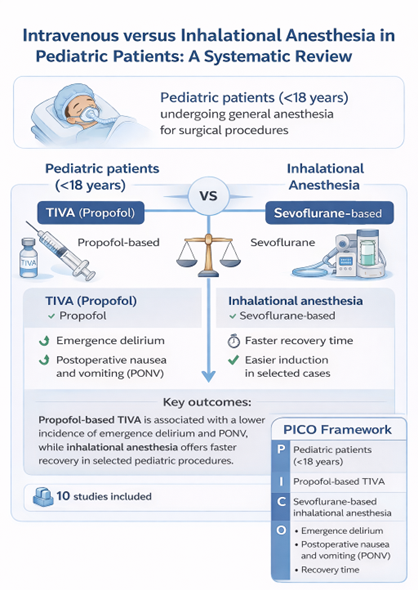
Background: The administration of anesthesia in pediatric patients requires special consideration due to physiological differences compared to adults. General anesthesia in children can be performed using total intravenous anesthesia (TIVA) or inhalational anesthesia. The selection of an optimal anesthetic technique plays a crucial role in minimizing perioperative complications and improving clinical outcomes.
Objective: To evaluate and compare the effectiveness and safety of intravenous anesthesia versus inhalational anesthesia in pediatric patients.
Methods: A systematic review was conducted using PubMed Central, the Cochrane Library, and Google Scholar databases up to 2025. This systematic review was registered in the PROSPERO database (registration number: 1302933). Studies comparing propofol-based TIVA with inhalational anesthesia, particularly sevoflurane, in pediatric patients (<18 years) were included. Outcomes analyzed included emergence delirium (ED), postoperative nausea and vomiting (PONV), recovery time, and airway complications.
Results: Most studies demonstrated that propofol-based TIVA was associated with a lower incidence of ED and PONV compared to inhalational anesthesia. However, several studies reported faster recovery times with inhalational anesthesia.
Conclusion: TIVA offers advantages in reducing the incidence of ED and PONV in pediatric patients, while inhalational anesthesia remains superior in terms of ease of induction and recovery time under certain clinical conditions.
Keywords: pediatric anesthesia, TIVA, inhalational anesthesia, propofol, sevoflurane.
Full Text:
PDFReferences
Smith J, Morgan A. Understanding epidemiology. 7th ed. New York (NY): Academic Press; 2020.
Ortiz AC, et al. Comparison of propofol and sevoflurane anesthesia in children. Anesth Analg. 2014;119(3).
Scheiermann P, et al. Total intravenous anesthesia versus inhalational anesthesia in pediatric patients: a meta-analysis. Pediatr Anesth. 2018;28(6).
Sheikhzade D, et al. Recovery profile of propofol versus sevoflurane anesthesia in children. J Clin Anesth. 2020;62.
Wu J, et al. Comparison of recovery time between propofol and sevoflurane in pediatric anesthesia. BMC Anesthesiol. 2020;20.
Amiri M, et al. Incidence of postoperative nausea and vomiting in pediatric anesthesia. Iran J Anesthesiol. 2020.
Roodneshin F, et al. Emergence delirium in children: TIVA versus inhalational anesthesia. J Pediatr Surg. 2023;58(4).
Xu Y, et al. Effect of anesthesia technique on postoperative outcomes in children. Front Med. 2023;10.
Sarhan M, et al. Propofol-based total intravenous anesthesia versus sevoflurane anesthesia in pediatric patients. Egypt J Anaesth. 2024;40(1).
Subramanian S, et al. Comparison of postoperative nausea and vomiting in pediatric anesthesia. Indian J Anesth. 2024;68(2).
Hamad A, et al. Pediatric anesthesia outcomes: propofol versus sevoflurane. Anesth Res Pract. 2025;2025.
Xiao Y, et al. Efficacy of propofol for the prevention of emergence agitation after sevoflurane anaesthesia in children: A meta-analysis. Frontiers in surgery. 2022; 1-12.
Xu et. al. Comparison analysis of safety profiles and identification of risk factors for postoperative adverse reactions: propofol versus sevoflurane in pediatric anesthesia. AJTR.2023;4658-67
Zhang Y, et al. Association of volatile anesthesia exposure and depth with emergence agitation and delirium in children: Prospective observasional cohort study. Frontiers surgery.2023;1-9
Abdallah, et al.Comparison of post operative pain in children after maintenance anaesthesia with propofol or sevoflurane: a systematic review and meta-analysis. BJA: 2024; 93-102
Refbacks
- There are currently no refbacks.